



When the Caregivers Are Left Uncared For
Fair Pay is a Right, Not a Privilege: Nurses Protest Across Nepal

Nepal health news, kathmandu : This is a collective voice of nurses across Nepal the silent strength behind every hospital, yet among the most overlooked and underpaid professionals in the nation's health system. This is not a personal story; it represents the experience of thousands of nurses nationwide.
A Cry That Should Never Have Been Needed
The ongoing protest of nurses across Nepal is heartbreaking. Those who dedicate their lives to caring for others are now forced to fight for something as basic as fair pay. Nurses, who keep hospitals running day and night, are standing on hospital grounds demanding what is already guaranteed by the Constitution under Article 34 the right to fair labour practices and appropriate remuneration.
The Hospital Reality
In many private hospitals, nurses earn between Rs. 10,000 and 15,000 per month -sometimes even less while patients are charged lakhs for deluxe rooms, suite cabins, and other services. Hospital owners are multi-millionaires, yet the backbone of their institutions -the nurses struggle to survive, while some highly paid professionals earn in lakhs. Government circulars mandate minimum wages, but in practice, little changes.
Nurses continue to face disrespect, lack of recognition, limited professional growth, and emotional exhaustion, making their work environment extremely challenging. Hospitals often justify high patient charges by citing constitutional and policy loopholes, claiming autonomy under the Private Health Institutions Regulation and the Right to Enterprise.
Yet these same institutions pay nurses and staff below government scales, claiming it is "beyond their capacity." Ironically, government facilities pay nurses far higher under the same laws. The Constitution of Nepal explicitly guarantees the right to fair labour practices (Article 34) and the right to basic health services (Article 35).
If hospitals can raise treatment costs beyond government rates, why can they not take equal responsibility to ensure fair wages for those who deliver the very care they profit from? This contradiction exposes both financial injustice and moral failure..
A Global Issue, a Local Neglect
The exploitation of nurses is not limited to Nepal. In India, nurses earn far below government scales, sparking repeated protests. In China, unsafe nurse-to-patient ratios lead to burnout and declining care quality. In the UK, nurses strike as inflation erodes income. In Nepal, however, the problem runs deeper. Asking for fair pay is often treated as disobedience. Videos circulate showing administrators telling nurses to "leave if not satisfied," which is utterly disrespectful, In another instance, a hospital representative reportedly asked whether a nurse should be held responsible if a patient died in the ward, simply because she had gone on protest over a few thousand rupees.
He implied nurses must remain fully accountable even while demanding rightful wages. Many have witnessed situations where hospital charges are prioritized over patient health, enforced through policies made by administrators. Shouldn't they reflect on their own responsibility instead of prioritizing money over patients, especially when deposits or payment slips are demanded during emergencies or in the ICU? Accountability is required from everyone, everywhere.
When Health Becomes Business
Hospitals were meant to be sanctuaries of healing, not factories of profit. Yet the health sector has largely become a business empire. Owners earn millions, while nurses and paramedics those who sustain their institutions are treated as replaceable assistants.
When those who provide care are mentally, emotionally, and financially drained, the system cannot claim to be healthy. This ongoing neglect worsens the mental, physical, social, and emotional health of the very workers who sustain the nation's healthcare system a reality that contradicts the institutions' stated vision and mission.
Invisible Pillars of Care
Every hospital runs on the invisible strength of nurses. They are the bridge between patients and other healthcare workers the eyes that notice warning signs and the hands that comfort. Yet they remain unheard and underpaid. When nurses speak up, they are labelled rebellious and even threatened with the loss of future opportunities. When they stay silent, they are forgotten.
Many leave the country seeking dignity, while those who remain serve under pressure until frustration peaks. According to the latest data from the Nepal Nursing Council (NNC), as of March 2024, there are approximately 82,471 registered nurses in Nepal, and over 40,000 have obtained verification letters to practice abroad.
This shows how widespread frustration and lack of support are driving thousands to seek better opportunities overseas. This is not just a financial crisis; it is a moral one. The one who stays beside the vulnerable has become vulnerable themselves.
Imagine a Hospital Without a Nurse
To every hospital owner, administrator, policymaker, and citizen imagine walking into a hospital with no nurse. Your loved one is sick; the doctor suggests admission but there is no one to provide care, monitor vitals, administer medicine, perform procedures, or offer comfort.
To the head of a multi-million-rupee hospital imagine your empire without nurses. Would your profits still rise? Without nurses, your hospital would collapse within hours, and your title. as a "healthcare entrepreneur" would lose all meaning. A hospital without nurses is not a hospital it is a building filled with equipment and silence.
Institutions That Forgot Their Purpose
Bodies like the Nepal Nursing Association (NNA) and the Nepal Nursing Council (NNC) were established to protect and uplift the profession. Yet, for many nurses, these institutions now feel distant focused more on paperwork than on fighting for fair wages and dignity.
Advocacy has become routine rather than revolutionary. How can a profession thrive when its protectors issue statements but fail to take real action, allowing injustices to persist for so long? We see news statements from them, but what is needed is a true revolution not just statements, meetings, and formalities, but a full-fledged effort with meaningful outcomes.
The Voices That Go Unheard
This voice is not of one nurse or one hospital it speaks for thousands. Despite repeated protests, nurses' voices rarely receive the attention that other professions do. When mental health issues are raised in some sectors, immediate action follows.
But when nurses or paramedics speak of burnout, exploitation, and despair, the nation remains silent. In our country, there is a tendency to glorify some and demoralize others, offering them the sight of just "assistants." This silence is not ignorance; it is indifference one that endangers both workers and the foundation of healthcare.
A Call That Cannot Wait
A hospital cannot heal if its healers are hurting. If private hospitals can charge premium rates and pay some professionals in lakhs, they can surely pay fair wages to the rest. The govemment must go beyond issuing notices it must monitor, enforce, and penalize those violating laws and exploiting workers for profit. Fair pay is not a favour; it is a right, guaranteed by the Constitution.
The World Health Organization defines health as complete physical, mental, and social well-being-yet those who ensure this health are often deprived of their own. If this continues, health will no longer. be a right but a privilege where a few grow rich while those who protect lives are left unseen.
The Final Plea
At this point, silence is no longer an option. The irony is painful institutions that claim to protect health have turned the lives of their own workers into a struggle for survival. If they truly cared about public health, they would care for those who sustain it-their every other staff.
To the government and health authorities enough of statements, enough of ceremonial promises. Action is needed now. The next time you visit a hospital, do not be impressed by gestures; do not just inaugurate extended services and offer congratulations; do not allow healthcare workers to be exploited while healthcare business flourishes.
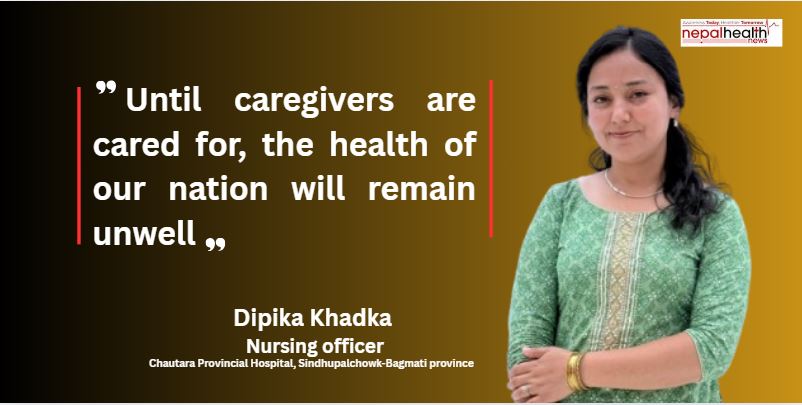
Ask questions about the staff and their salaries, and hold institutions accountable. Nurses are not asking for privilege; they are asking for justice justice grounded in the fundamental laws of the land -The Constitution of Nepal. This protest is not defiance; it is a cry for fairness and a plea to restore dignity. Until caregivers are cared for, the health of our nation will remain unwell.