



A Support for the Childless: Dr. Sanumaiya's Voice Reaches Tokyo

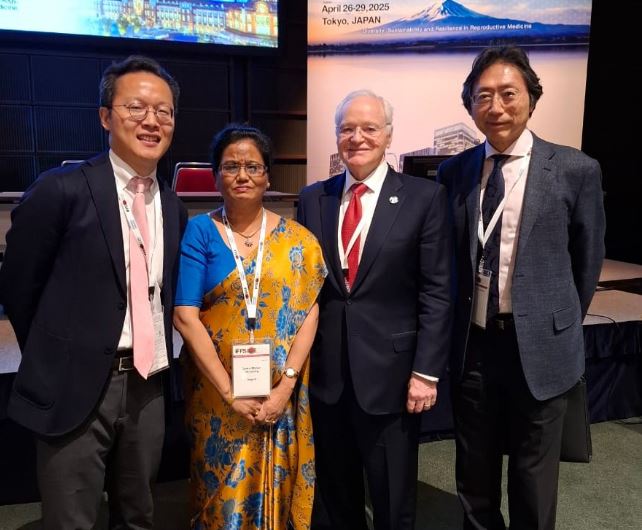
Nepal Health News, Tokyo, Japan – At the 2025 World Congress of the International Federation of Fertility Societies (IFFS), Nepal’s senior infertility and IVF specialist Dr. Sanumaiya Shrestha Pradhan presented a paper on the current status and challenges of IVF services in Nepal.
The congress, held in Tokyo, Japan from April 26 to 30, featured Dr. Shrestha’s presentation titled “Current Status and Challenges in Assisted Reproductive Technology Treatment Services in Nepal.”
To prepare her paper, Dr. Shrestha conducted surveys of IVF centers in Nepal and collected data from the Ministry of Health and Population. As part of the symposium titled “Real Data and Global Fertility Knowledge,” representatives from countries including Japan, China, Nigeria, and Nepal presented on their nations’ IVF services, technologies, and data. Experts from various countries—including Nepal, India, China, Africa, the United States, the UK, Australia, and Russia—attended the conference. Dr. Shrestha described the event as “well-organized, enriching, and highly informative.”
According to her, the conference showcased recent technological advancements such as in vitro maturation (IVM), dormant follicle activation, and piezo-ICSI, providing insight into the rapid progress being made in the field of IVF.
While IVF services have expanded in Nepal, Dr. Shrestha noted challenges related to service quality, data management, unified guidelines, and lack of government support. “There is some practice of data recording, but there is no uniformity or quality control,” she stated.
According to data presented at the conference, Japan’s birth rate has dropped to 0.9 percent, while the global average stands at 1.3 percent. Dr. Shrestha expressed concern that Nepal’s birth rate is also declining, emphasizing the need to improve IVF services and expand accessibility.
Highlighting Japan’s model—where IVF services are made accessible through insurance—Dr. Shrestha stressed the need for policy and technological reforms in Nepal. In Japan, the live birth rate through IVM is 35 percent, while traditional IVF has a 43 percent success rate.
Dr. Shrestha, Nepal’s first IVF specialist, has been working in the field of infertility and IVF for over 20 years. She is currently affiliated with Creators IVF Nepal, located in Satdobato, Lalitpur.