



Men go abroad, women get diseases – the pain of Karnali
The Need for and Experience of Cancer Screening in Sudurpaschim and Karnali

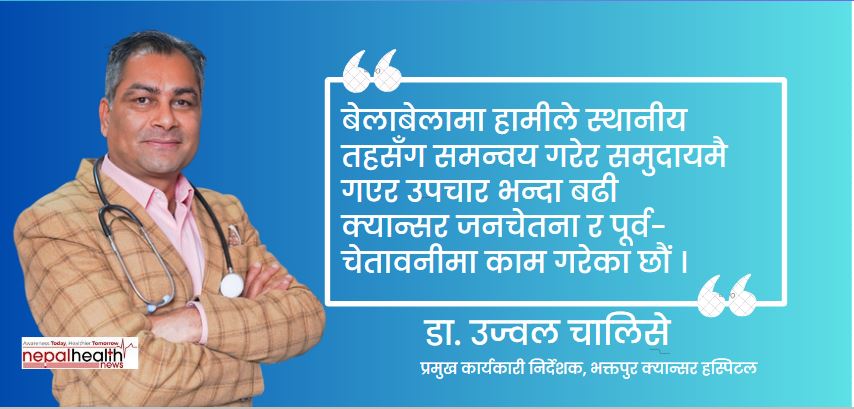
Nepal Health News, Kathmandu Interview: Dr. Ujwal Chalise, Chief Executive Director, Bhaktapur Cancer Hospital
Question: Dr. Ujwal, why is cancer screening necessary?
Answer:
Anyone can get cancer, so it's crucial to detect it early. The earlier it’s detected, the sooner it can be treated and cured. Screening refers to the process of identifying the possibility of cancer in people who show no specific symptoms.
In Nepal, screening may not be effective for all types of cancer. However, it is considered very useful for cervical and breast cancer in women.
We have been organizing screening camps in remote areas. From Chaitra 22, 2081 (April 4, 2025), we carried out a week-long campaign in Achham, Dadeldhura, and Kailali districts of Sudurpaschim Province, where we screened more than 1,750 women.
Question: How many people were screened? What were the results?
Answer:
Achham, Ramaroshan Rural Municipality, Mugabagar:
-
450 women were screened for cervical and breast cancer.
-
15 were suspected of having cancer; 5 were confirmed cases.
-
Some samples were collected for testing, and advice will be provided based on the reports.
Dadeldhura Hospital:
-
About 300 women were screened for cervical and breast cancer.
-
5 cancer patients came into contact; one was brought for immediate treatment.
Kailali, Bardgoriya:
-
More than 1,000 women were screened for cervical and breast cancer.
-
Suspected cases were referred for further treatment.
In total, more than 1,500 samples were collected for cervical cancer testing.
Question: What is the main objective of the screening camps?
Answer:
The main objective is to raise public awareness. The goal is to spread the message that cancer can be detected early through screening. From time to time, we coordinate with local levels and work directly in communities, focusing more on awareness and prevention than just treatment.
Question: What was the experience like during the camp in Karnali Province?
Answer:
Not everyone will get cancer, but it’s possible to assess who might be at risk later. The geography and social conditions of Sudurpaschim and Karnali are very challenging. Access to health services is limited.
Many men go to India for work, contract sexually transmitted infections, and transmit them to their wives—yet there's a trend of not treating the women. Our goal is to bring services to such areas, spread awareness, and work in collaboration with health institutions.
We observed many cases of uterine infections and uterine prolapse among women. Breast-related issues were rare, but uterine problems were common.
Question: Why do women not receive treatment even when they know they are ill?
Answer:
There are social and economic reasons:
-
Lack of awareness among women
-
Isolation and restriction within the home
-
Lack of support from husbands
-
Lack of assistance from the government and local authorities
In such cases, the role of local governments becomes crucial. The government currently provides up to NPR 100,000 worth of free treatment for serious diseases like cancer. However, the weakness lies in early detection. That’s why we’ve advised local governments to allocate budgets, use the insurance system, and increase awareness.
Conclusion:
The work that Dr. Ujwal Chalise and his team are doing in remote regions for early detection and awareness of a serious disease like cancer is highly commendable. Programs like these must continue in underserved communities with limited access to healthcare.