




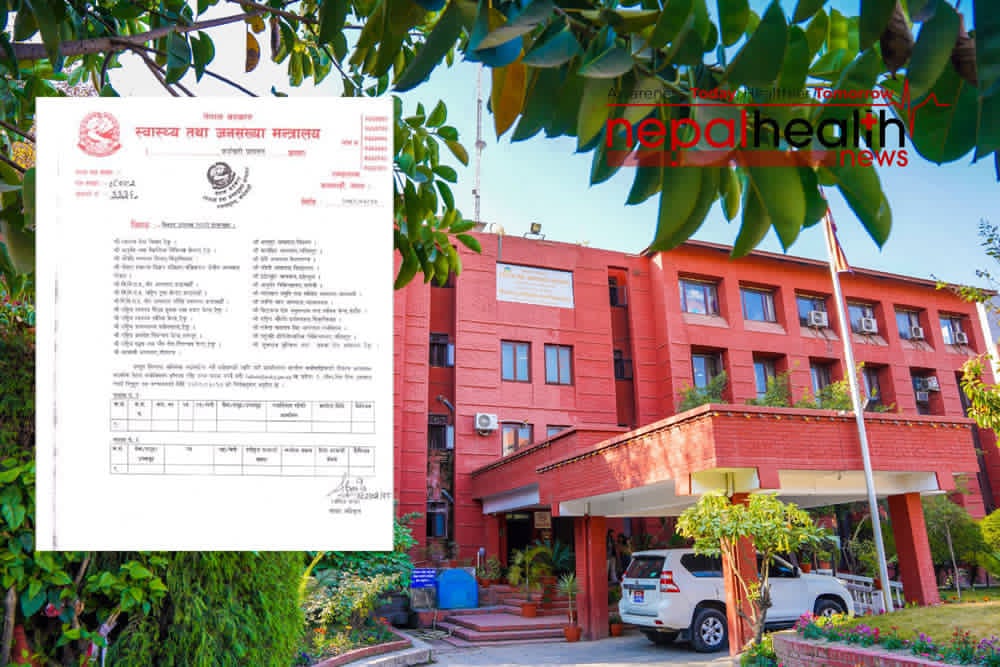
Nepal Health News, Kathmandu – The Ministry of Health and Population has demanded details of employees who are currently on deputation (kājmā) but have not reported to their designated workplaces. The ministry has issued a public notice directing subordinate hospitals and departments to collect and submit details of such employees within three days.
The ministry has tightened monitoring after it found that several employees working under the federal government in 13 hospitals and various departments had failed to report to their assigned postings. Earlier, on June 10 (Jestha 28), the ministry had issued a directive requiring employees on deputation or those transferred but not yet reporting to their posts to report for duty within three days. Those who fail to comply were warned of departmental action.
This time, for data collection, the ministry has included institutions such as the Department of Health Services, Department of Ayurveda and Alternative Medicine, Department of Drug Administration, Bir Hospital, Trauma Center, Kanti Children's Hospital, Sukraraj Tropical and Infectious Disease Hospital, among others.
According to the Ministry of Health, more than 300 employees are currently on deputation, and the nationwide number is estimated to be in the thousands. Within the ministry's own office alone, 24 employees are reportedly on deputation without fulfilling responsibilities as per their sanctioned posts.
In this context, former chief specialist of the ministry, Dr. Sushil Nath Pyakurel, commented that the deputation system is being grossly misused. According to him, the Health Services Act of 1996 (2053 B.S.) permits deputation for no more than 30 days in a year, but this rule has been openly violated. Despite the law being clear, the trend of keeping employees on long-term deputation continues unabated.
Dr. Pyakurel claimed that the misuse of the deputation system began during the tenure of former minister Rajendra Mahato. “Initially, the deputation system was used out of necessity,” he said, “but over time, it began undermining merit and assigning responsibilities to unqualified individuals.”
He noted that the principle of “right person in the right job” has been completely ignored, citing several examples of technically mismatched assignments: appointing orthopedic surgeons as heads of epidemic control, assigning surgeons to lead administrative divisions, and making anesthesiologists the heads of infectious disease hospitals. He argued that such decisions are unjustified